

Extra Time and Penalties Complicate More Bets Than Fans Expect
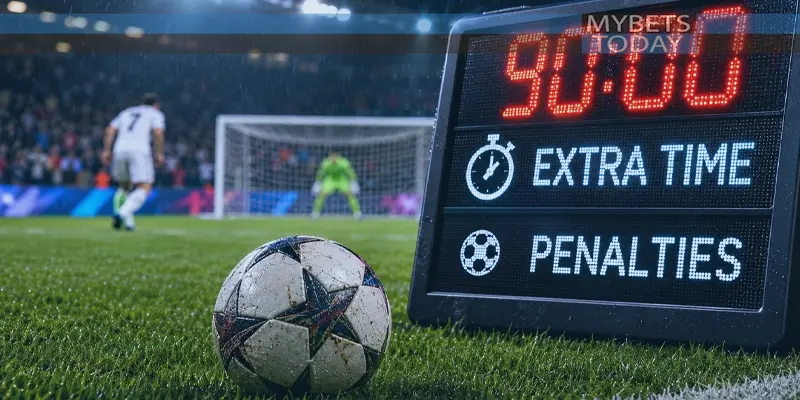
Why knockout football creates more confusion than ordinary matches
Football betting is usually straightforward when it comes to domestic league matches. Two teams play 90 minutes, the referee adds stoppage time, and the final result determines the outcome of most betting markets. Whether you backed the home team, the away team, a draw, or a particular number of goals, the result is normally settled when regular time finishes.
Knockout football introduces a completely different situation. In competitions where one team must eventually progress, a match that finishes level can continue into extra time and possibly a penalty shootout. This creates an important distinction between the team that wins the tie and the result used to settle a particular bet.
Many casual bettors assume that backing a team to win means the selection will be successful if that team eventually progresses. Unfortunately, that is not always how football betting works. A team can win a cup final on penalties while the standard match winner bet on that same team loses.
The reason is that bookmakers offer different markets covering different periods of the match. Some selections are settled after 90 minutes, others include extra time, and specific markets focus on which team eventually qualifies or lifts the trophy.
This distinction affects much more than the basic match winner market. Total goals, correct score, Both Teams To Score, Asian Handicap, Double Chance, corners, cards, player statistics, and accumulators can all be influenced by the difference between regular time and additional periods.
For bettors who regularly follow the Champions League, Europa League, Conference League, domestic cup competitions, and international tournaments, understanding these rules is just as important as analysing the teams themselves.
The difference between regular time, extra time and penalties
Before looking at individual betting markets, it is important to understand how football matches are divided for settlement purposes. These distinctions may sound basic, but they are responsible for many avoidable betting mistakes.
Regular time includes stoppage time
Regular time consists of two halves of 45 minutes, together with any stoppage time added by the referee. A goal scored in the 93rd or 97th minute is still considered part of regular time, even though the match clock has passed 90 minutes.
This is important because most standard football betting markets cover 90 minutes plus stoppage time. They do not automatically include extra time.
Extra time is a separate period
When the competition rules require it, a knockout match that finishes level can continue for another 30 minutes. This normally consists of two periods of 15 minutes, with additional stoppage time possible.
Goals, corners, cards, and other events during extra time may be excluded from standard betting markets unless the relevant rules specifically include them.
Penalty shootouts determine the winner separately
If the teams remain level after extra time, a penalty shootout may be required. Some competitions also move directly from regular time to penalties without playing extra time.
Successful penalties during a shootout do not count as ordinary match goals. They determine the winner of the tie, but they do not change the football score used for standard goals markets.
Understanding these three stages is the foundation for making better decisions in knockout betting.
Why a team can win the match while your bet loses
Imagine a Champions League knockout fixture between two evenly matched teams. You expect the home side to win and place a standard 1X2 match winner bet.
After 90 minutes, the match finishes 1-1. During extra time, the home team scores another goal and eventually wins 2-1.
From a football perspective, your prediction about the eventual winner was correct. However, the standard match winner selection loses because the home team did not win during regular time.
The successful selection in the original 1X2 market was the draw.
This situation can surprise bettors who focus entirely on the final result shown by television broadcasts or sports applications. The match report may describe a 2-1 victory, but the bookmaker can still settle the regular-time result as a 1-1 draw.
There is nothing contradictory about these outcomes. They simply refer to different stages of the same match.
The distinction becomes especially important when backing strong favourites. A better team may have a high probability of eventually progressing, but that does not necessarily mean it will secure victory within the first 90 minutes.
Match Winner and To Qualify are completely different markets
Two of the most important markets in knockout football are Match Winner and To Qualify. They may involve the same teams, but they ask different questions and often offer significantly different odds.
Standard Match Winner
The standard 1X2 market normally offers three possible outcomes: home win, draw, or away win. Settlement takes place using the score after regular time, including stoppage time.
If the match finishes level after 90 minutes, the draw is the winning selection even when one team eventually wins through extra time or penalties.
To Qualify or To Advance
The To Qualify market asks which team will progress to the next round. This generally includes whatever procedures are required to determine the winner, including extra time and penalty shootouts where applicable.
If a team draws after 90 minutes but wins the penalty shootout, a To Qualify selection on that team normally wins.
This can be a suitable market when you trust one team to progress but expect the match to remain competitive throughout regular time.
However, qualification odds are generally shorter than standard match winner odds because they cover more possible paths to success. That additional protection comes at a price, and bettors must decide whether the reduced return is worthwhile.
Two-legged knockout ties introduce another complication
European knockout competitions often involve two-legged ties where the aggregate score determines which team progresses.
Imagine Team A wins the first leg 3-1. In the second leg, Team B wins 1-0. Team B has won the second match, but Team A progresses because the aggregate score is 3-2.
A standard match winner bet on Team A in the second leg loses because Team A lost that particular game. However, a To Qualify selection on Team A wins because the club progresses to the next round.
The opposite can also happen. A team may win the second leg but still be eliminated because of a heavy defeat in the first match.
This is why bettors must distinguish between predicting the result of a particular fixture and predicting the outcome of the overall tie.
The first-leg result also influences motivation and tactics. A team defending a comfortable aggregate advantage may be willing to accept a narrow defeat. Another side may need to attack aggressively from the opening minute because only a victory by a significant margin will keep its qualification hopes alive.
These circumstances can affect match winner, handicap, total goals, and player markets.
Extra time can completely change the meaning of Over and Under Goals
Total goals markets are among the most popular options in football betting. They are also among the markets where extra time can create the greatest confusion.
Consider a knockout match that finishes 1-1 after regular time. During extra time, one team scores twice, producing a final score of 3-1.
A standard Over 2.5 Goals bet loses because only two goals were scored during the original 90 minutes plus stoppage time.
The additional goals during extra time do not change the settlement of that standard selection.
However, if the bookmaker offers a market specifically including extra time, those additional goals may count towards the total.
This is why a selection described as Over 2.5 Goals is not necessarily equivalent to Over 2.5 Goals Including Extra Time.
The same principle applies to Under markets. A standard Under 2.5 Goals selection can win when regular time finishes 1-1, even if several more goals are scored during extra time.
Another detail is that more playing time does not automatically mean more goals. Extra time can become extremely cautious, particularly when both teams are tired and neither manager wants to risk conceding a decisive goal.
For bettors, the correct approach is to understand both the settlement period and the likely tactical behaviour during that period.
Correct Score betting requires even more attention
Correct Score betting is already difficult because the bettor must predict the exact scoreline. Knockout matches create another challenge because the score can change after the original market has been settled.
Imagine backing a 1-1 correct score. The match finishes 1-1 after 90 minutes, but the home team scores during extra time and eventually wins 2-1.
A standard 90-minute correct score selection of 1-1 wins because that was the result at the end of regular time.
The additional goal does not change the outcome of the original selection.
Now imagine backing 2-1 because you expect the home team to eventually win. If that scoreline only arrives during extra time, the standard correct score selection loses.
Some bookmakers also offer separate markets for the correct score during extra time. These may use only the goals scored during the additional period rather than the cumulative match score.
For example, if regular time finishes 1-1 and the final score after extra time is 2-1, the result during extra time alone was 1-0.
This difference is particularly important when placing live bets after the first 90 minutes have ended.
Both Teams To Score can produce unexpected outcomes
Both Teams To Score is another market where the difference between regular time and extra time can lead to misunderstanding.
Imagine a cup final finishes 0-0 after regular time. During extra time, both teams score and the match finishes 1-1 before penalties.
A standard BTTS Yes selection loses because neither team scored during the original 90 minutes plus stoppage time.
Even though both teams eventually found the net, those goals happened outside the period covered by the bet.
The opposite example is equally important. If both teams score during regular time, a standard BTTS Yes selection wins regardless of what happens during extra time or penalties.
This means bettors should never judge the settlement of a standard BTTS selection only by looking at the final score after every possible period.
It also shows why understanding the competition format matters. A match expected to go into extra time may have a different scoring pattern from a normal league fixture, especially when both managers are comfortable accepting a draw after 90 minutes.
Asian Handicap markets do not automatically include extra time
Asian Handicap is often used to provide additional flexibility compared with a standard match winner bet. However, these markets do not automatically cover extra time or penalty shootouts.
Suppose you back a team at Asian Handicap 0, also known as Draw No Bet. The match finishes 0-0 after regular time, but the selected team eventually wins during extra time.
Under standard regular-time Asian Handicap rules, the original stake is refunded because the score after 90 minutes was level.
The extra-time victory does not transform the original selection into a winning bet.
Similarly, backing a team at -0.5 means that team must win during the period specified by the market. Winning only in extra time would not be enough for a standard 90-minute handicap.
Positive handicaps work according to the same principle. A team backed at +0.5 can successfully cover the handicap by drawing after regular time, even if it eventually loses during extra time.
This is why a qualification selection and an Asian Handicap selection should never be treated as interchangeable.
Double Chance can create surprising results
Double Chance allows bettors to cover two of the three possible outcomes in the standard 1X2 market.
The three common options are 1X, X2, and 12.
-
1X covers a home win or a draw.
-
X2 covers an away win or a draw.
-
12 covers either team winning, excluding the draw.
Imagine a knockout match finishes 1-1 after 90 minutes before the home team wins during extra time.
Both 1X and X2 win in the standard regular-time Double Chance market because the result after 90 minutes was a draw.
However, the 12 selection loses because neither team won during the period covered by that market.
This may seem strange when one team eventually celebrates victory, but the settlement is consistent with the original market conditions.
Player Goalscorer markets can follow different rules
Player betting introduces another complication because bookmakers do not always apply identical settlement conditions.
Some anytime goalscorer markets include extra time, while others are limited to regular time. Similar differences can exist for player shots, assists, tackles, and other individual statistics.
Imagine a striker fails to score during the first 90 minutes but finds the net in the 110th minute.
Whether an anytime goalscorer selection wins depends on the specific bookmaker and the rules attached to that market.
This is why it is unsafe to assume that every player market follows the same rules as a standard match winner selection.
The same issue can affect player shots on target. A forward may record several additional attempts during extra time, but those events may not count if the original market covers only regular time.
Before placing player bets during knockout competitions, bettors should check whether extra time is included and how the bookmaker handles substitutions and players who do not participate.
These details can be particularly important when a match is expected to remain close and several players may complete more than 90 minutes.
Corners and cards can stop counting after regular time
Corners and cards markets have become increasingly popular, especially among bettors who analyse match pressure, physical intensity, tactical styles, and referee behaviour.
However, many standard pre-match statistics markets count only events from regular time.
Imagine a knockout fixture produces eight corners during the first 90 minutes and another five during extra time.
A standard Over 9.5 Corners selection would lose if the market covers only regular time, despite the match eventually producing 13 corners overall.
Cards markets can create similar confusion. A match may produce three yellow cards during regular time and several more during extra time.
If the original selection excludes extra time, those additional bookings do not count towards settlement.
There can also be differences between bookmakers regarding booking points, second yellow cards, direct red cards, and disciplinary actions involving substitutes or coaching staff.
These details become especially important in knockout matches because fatigue and emotional pressure can increase the risk of late challenges and disciplinary incidents.
Bettors should therefore check both the period covered by the market and the specific rules used to count cards.
Penalties during the match are different from penalty shootouts
One of the most important distinctions concerns the difference between a penalty awarded during normal play and a penalty taken during a shootout.
A penalty awarded during regular time is an ordinary football event. If the player scores, that goal counts towards the match score and the relevant betting markets.
A penalty scored during extra time also counts as a match goal, although only selections including that period will use it for settlement.
Penalty shootouts are different.
Suppose a match finishes 0-0 after extra time and one team wins the shootout 5-4.
The nine successful shootout penalties do not turn the official football score into 5-4 for standard goals betting.
The match remains 0-0, with the penalty shootout recorded separately.
Those successful penalties also do not count towards ordinary anytime goalscorer selections or standard Over goals markets.
Bookmakers may provide specific shootout markets, but they should never be confused with ordinary match betting.
Accumulators can be ruined by one incorrect market selection
Extra time and penalties can be particularly frustrating for accumulator bettors because one misunderstanding can affect an entire combination.
Imagine placing a four-match accumulator. Three selections are standard match winners, while the fourth involves a team expected to qualify from a knockout fixture.
The first three teams win during regular time. The fourth team draws after 90 minutes but eventually wins on penalties.
If the final selection was correctly placed in the To Qualify market, all four legs can win.
However, if the bettor accidentally selected the standard match winner market for that final fixture, the last leg loses because the team did not win during regular time.
The difference may be only a few words in the market description, but the financial outcome can be completely different.
Bet builders can add further complications because individual components may have their own settlement conditions.
Combining player goals, match statistics, corners, cards, and results inside the same knockout fixture requires particular attention to these rules.
Extra time changes the physical and tactical balance
Beyond settlement rules, extra time can change the nature of the football match itself.
After 90 minutes, players may already be physically exhausted. Recovery runs become slower, passing accuracy can decline, and defensive concentration may become less reliable.
Teams with strong squad depth can benefit from introducing fresh players. Others may struggle because several important players have already been substituted or are carrying minor injuries.
However, fatigue does not automatically produce more goals.
Some matches become more open because defenders struggle to maintain their positions. Others become extremely cautious because neither manager wants to concede a decisive goal.
A team with a strong bench may decide to attack aggressively during extra time, believing it has a physical advantage. Another side may defend deeply and accept the possibility of a penalty shootout.
These tactical decisions can make extra-time markets difficult to predict using only statistics from regular time.
For bettors, it is important to consider the remaining substitutions, physical condition of key players, and the willingness of both teams to take risks.
Penalty shootouts require a completely different approach
Penalty shootouts can appear attractive because they produce a clear winner and loser. However, predicting the outcome is not as simple as comparing overall team quality.
A stronger team does not automatically have a decisive advantage during a shootout.
Individual penalty-taking ability, goalkeeper performance, preparation, confidence, and psychological pressure can all influence the result.
There is also significant uncertainty. A well-taken penalty can be saved, an experienced player can miss, and one goalkeeper decision can completely change the direction of the shootout.
A team that dominated the previous 120 minutes may enter penalties with confidence, but that does not guarantee success.
This makes shootout betting different from ordinary match winner analysis. Possession, total shots, and general attacking superiority do not necessarily translate into an equivalent advantage during penalties.
Bettors should therefore avoid assuming that the stronger team on paper is automatically the stronger shootout selection.
Live betting becomes more complicated when extra time begins
Live betting introduces another challenge because bookmakers may open entirely new markets when regular time finishes.
These can include the result during extra time, total extra-time goals, the next team to score, or the eventual winner.
Imagine a match finishes 2-2 after 90 minutes. A bookmaker then offers an Extra Time Over 0.5 Goals market.
That selection requires at least one goal during the additional period. The four goals scored during regular time do not count because the new market covers only extra time.
This distinction is particularly important when bookmakers display several similar markets at once.
Live odds can also change quickly because of fatigue, substitutions, injuries, and tactical adjustments.
A team that dominated regular time may begin extra time as the favourite, but the physical situation can change rapidly.
The strongest live betting decisions therefore require both an understanding of the settlement rules and an accurate reading of the current match conditions.
Competition rules can change the entire betting approach
Not every knockout competition follows the same format.
Some competitions use extra time before penalty shootouts. Others move directly from regular time to penalties. Two-legged tournaments can also use aggregate scores to determine whether additional periods are necessary.
These differences matter because the route to qualification can change the probability of different outcomes.
A bettor should understand the competition format before choosing between Match Winner, To Qualify, or other knockout markets.
It is also important to remember that competition rules can change between seasons.
Assuming a tournament still follows the same format as previous years can lead to unnecessary mistakes.
Before placing a selection, check how the match will be decided and whether the relevant market covers that procedure.
Common mistakes bettors make during knockout matches
Most betting mistakes involving extra time and penalties come from small assumptions rather than complicated calculations.
-
Assuming that a team winning on penalties means a standard match winner bet also wins.
-
Confusing stoppage time with extra time.
-
Expecting extra-time goals to count towards standard Over and Under Goals markets.
-
Using the score after extra time to judge a regular-time Correct Score selection.
-
Assuming all player goalscorer markets have identical settlement rules.
-
Counting successful shootout penalties towards ordinary match totals.
-
Ignoring the difference between winning one leg and qualifying from the overall tie.
-
Adding knockout selections to accumulators without checking the exact market.
-
Assuming every competition plays extra time before penalties.
These mistakes are avoidable. Most can be prevented by checking the exact market name and understanding which period determines settlement.
How to approach knockout betting more intelligently
A better betting process begins with one simple question. Are you predicting the result after 90 minutes, the score after extra time, or the team that eventually progresses?
Once that distinction is clear, choosing the appropriate market becomes much easier.
If you believe a strong favourite will win comfortably during regular time, the standard match winner market may fit your prediction.
If you believe the same team will eventually progress but the opponent has a realistic chance of forcing extra time, a qualification market may be more appropriate.
If you expect a cautious contest with limited attacking opportunities, regular-time Under Goals may deserve attention. However, the same market including extra time carries additional exposure because the teams may play another 30 minutes.
Player markets require particular care because their rules may differ between bookmakers.
Most importantly, the available odds must still offer reasonable value. A qualification market is not automatically a better bet simply because it includes extra time and penalties.
The protection comes with shorter odds, and that reduction must be justified by the estimated probability of success.
Understanding settlement rules is part of professional betting analysis
Football bettors often spend considerable time studying recent form, injuries, team news, tactical systems, and historical results.
All of these factors can help identify promising selections, but even excellent football analysis cannot rescue a bet placed in the wrong market.
You may correctly predict which team will lift a trophy but lose a standard match winner selection.
You may correctly expect three goals across 120 minutes but lose an Over 2.5 Goals bet that covers only regular time.
These situations do not necessarily mean the football prediction was poor. They mean the selected market did not match the prediction.
Understanding settlement conditions is therefore just as important as understanding the match itself.
Good betting decisions require three things to work together: a reasonable prediction, an appropriate market, and odds that justify the risk.
If any of these elements is missing, the selection may be much weaker than it first appears.
Final thoughts
Extra time and penalty shootouts complicate more football bets than many fans expect because the same match can produce several different results depending on the period being considered.
A team can draw after 90 minutes, win after extra time, or progress through penalties. Each outcome can be relevant to a different betting market.
Standard match winner, goals, Correct Score, Double Chance, and Asian Handicap markets normally focus on regular time unless otherwise stated. Qualification markets generally include the procedures needed to decide which team progresses, while player and specialist markets may follow additional bookmaker-specific rules.
The most important habit is to read the exact market description before placing a selection. Understand whether the bet covers regular time, extra time, or the eventual winner. Check how goals, corners, cards, player statistics, and penalty shootouts will be treated.
Knockout football creates memorable moments because matches can continue long after the original 90 minutes. For bettors, those additional periods introduce both opportunities and risks that do not always exist in ordinary league fixtures.
The difference between a winning bet and a losing one may have nothing to do with which team eventually celebrates. Sometimes it comes down to understanding exactly when the betting market was supposed to finish.
That is why learning how extra time and penalty shootouts affect settlement is not simply a technical detail. It is an essential part of making informed football betting decisions, particularly in competitions where progression matters more than the result after 90 minutes.