

BTTS and Over 2.5 Are Related But Not the Same Bet
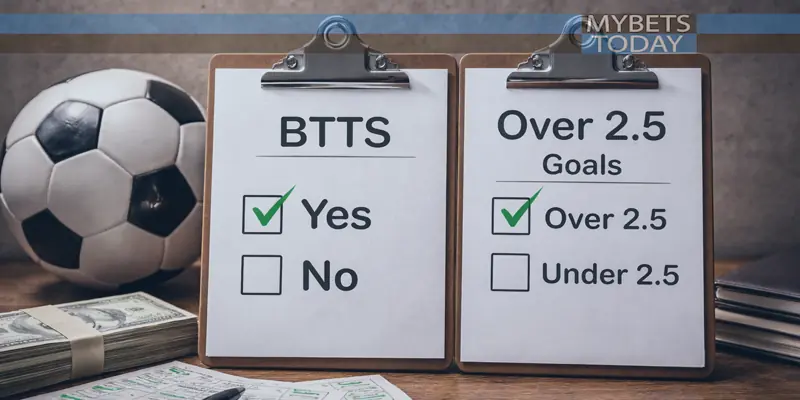
Many football bettors place BTTS and Over 2.5 goals in the same mental group
That is easy to understand because both markets usually attract people who expect an open match, attacking football, and chances at both ends. In many matches, the same kind of game can make both bets look strong. If both teams are dangerous in attack and neither side looks fully solid at the back, it is natural to think about both markets together.
Still, being related is not the same as being identical. BTTS and Over 2.5 goals are connected, but they are not the same bet at all. They ask different questions, they win in different scorelines, and they can lead bettors into mistakes when people treat them as if they are interchangeable. That is one of the main reasons many casual bettors get confused. They see overlap between the 2 markets and assume that picking one is almost the same as picking the other. It is not.
BTTS is short for Both Teams To Score. That market only cares about one thing. Each team must score at least 1 goal. It does not matter if the final result is 1 to 1, 2 to 1, 3 to 2, or even 5 to 4. If both teams score, the bet wins. If one team fails to score, the bet loses.
Over 2.5 goals is different. That market only cares about the total number of goals in the match. You need 3 or more goals in total for the bet to win. It does not matter if one team scores all of them or if both teams contribute. A 3 to 0 win counts the same as a 2 to 1 win in this market. As long as the total reaches at least 3 goals, the bet wins.
That difference is simple, but it matters a lot. A match can land on BTTS without going over 2.5. A match can also go over 2.5 without landing on BTTS. That alone shows why these bets are related, but clearly not the same.
What BTTS Really Asks
BTTS is a market about balance in scoring. It is not really asking whether the match will be high scoring in general. It is asking whether both sides can find the net at least once. This often makes it a useful market in matches where each team has some attacking threat, but where the total goal count may still stay moderate.
For example, a match that ends 1 to 1 is a winning BTTS bet, but Over 2.5 goals loses. That one scoreline tells you everything you need to know about the market. BTTS does not need a goal festival. It just needs contribution from both sides.
This is why BTTS can be attractive in matches between teams that attack well enough to score but not always well enough to create a very high total. It can also be useful in games where both defences are a little shaky, even if the overall pace of the match is not expected to be wild from start to finish.
What Over 2.5 Really Asks
Over 2.5 goals is a market about volume. It is only asking whether the match reaches 3 or more goals in total. It does not care how those goals are shared between the teams. One team can dominate and score all 3. The match can also end with each team scoring. The route does not matter as much as the total.
That means Over 2.5 can win in matches where BTTS never had a chance. A 3 to 0, 4 to 0, or 5 to 0 result all cash Over 2.5, while BTTS loses because one side stayed scoreless.
This makes Over 2.5 useful in matches where one strong team may do most of the damage on its own. If you expect a big favourite to create many chances and possibly score 3 by itself, Over 2.5 may still be a good angle even if you do not trust the weaker side to score.
Why People Mix Them Up
The reason people connect these markets so often is that many scorelines make both bets win. A 2 to 1 result lands BTTS and Over 2.5. A 2 to 2 result lands both as well. A 3 to 1 or 4 to 1 also lands both. Because these outcomes are common in open matches, bettors start to think the markets are almost twins.
But that is only part of the picture. The overlap is real, but so are the differences. If you ignore the differences, you can easily choose the wrong market for the type of match you actually expect.
Think about these scorelines:
-
1 to 1 wins BTTS and loses Over 2.5
-
2 to 0 loses BTTS and loses Over 2.5
-
3 to 0 loses BTTS and wins Over 2.5
-
2 to 1 wins BTTS and wins Over 2.5
Those examples make the difference very clear. The 2 bets often travel together, but not always. And when they split, the logic behind each market becomes much more important.
When BTTS Can Be Better Than Over 2.5
There are many matches where BTTS may be the smarter option. One good example is a game between 2 teams that usually score but do not always play at a very high tempo. If both sides are capable of finding 1 goal, but neither team is especially explosive, a 1 to 1 result may feel very live. In that kind of match, BTTS can make more sense than Over 2.5.
Another example is a game between teams with vulnerable defences and average attacks. These teams may gift each other chances, but not necessarily produce a flood of goals. Again, BTTS can fit better if the most likely idea is that both sides score once rather than one side running away with the game.
BTTS can also be attractive in balanced league matches where both teams need points and both carry some attacking intent, but where the overall structure of the game may still limit the total. A 1 to 1 draw is often a very live result in these situations.
When Over 2.5 Can Be Better Than BTTS
Over 2.5 may be the stronger market when you trust one team much more than the other. Imagine a powerful home side facing a weak away team with a poor defence. If you believe the favourite can score 3 goals on its own, then Over 2.5 can be a very logical bet even if you do not expect the underdog to score at all.
This market can also be stronger when one team is highly aggressive and the other side may collapse under pressure. Some matches are not balanced enough for BTTS, but they are still great for total goals because one team can create most of the total by itself.
Another good use of Over 2.5 is when a match has the potential to become stretched. If an early goal changes the game state and forces the losing side to open up, the match can quickly reach 3 goals even if only one team is doing most of the scoring.
How Match Style Changes the Choice
Style matters a lot when choosing between these 2 markets. A match with 2 aggressive teams that both press high, leave space behind, and attack with numbers may support both bets. But even then, you should still ask which market fits the match better.
If both teams look likely to create chances, BTTS may be a strong option. If one side looks far more dangerous and the other side mainly looks weak at the back, Over 2.5 may fit better.
It is also important to look at how teams score and concede. Some teams score regularly but also sit deeper after taking the lead. Some teams concede first and then become much more open. Some teams create many chances at home but offer very little away. These details help you decide whether you need both teams to contribute or whether one team can carry the total.
If you want to compare match ideas and see examples of games where both sides look capable of scoring, it can help to check both teams to score predictions and measure those picks against the likely total goal pattern of the match. That is often a useful way to understand whether BTTS alone is the better angle or whether the game also points strongly toward Over 2.5.
Common Mistakes Bettors Make
Assuming BTTS always means Over 2.5
This is one of the most common mistakes. A lot of bettors see 2 teams with scoring potential and instantly think Over 2.5 as well. But 1 to 1 is always a danger in that logic. If your real expectation is that both teams score once, BTTS is probably the cleaner bet.
Forgetting that one team can cover Over 2.5 alone
Some bettors avoid Over 2.5 because they do not trust one side to score. But if the stronger team is capable of scoring 3 or more by itself, the market can still be strong. You do not always need balance for Over 2.5 to land.
Looking only at goals scored
Raw scoring numbers do not tell the full story. You should also think about game state, home and away split, tactical style, chance creation, and how teams react after scoring or conceding. Those details often explain whether a match is more likely to become 1 to 1 or 3 to 0.
Picking the market with the bigger price without proper logic
Sometimes bettors choose BTTS or Over 2.5 simply because the odds look a little better. That is not a strong reason on its own. The market should match the way you expect the match to unfold.
Can Both Bets Be Good At The Same Time
Yes, absolutely. In many open matches, both bets can make sense. If 2 teams are strong going forward, shaky in defence, and likely to attack for most of the game, BTTS and Over 2.5 can both be good selections. That is why the markets are so often linked in the minds of football bettors.
Still, even in those cases, it helps to know what you are really backing. BTTS is still about both teams contributing. Over 2.5 is still about total goal count. Understanding that difference keeps your thinking sharp and helps you avoid lazy decisions.
Which Market Is Safer
There is no universal answer because safety depends on the type of match. In some games, BTTS may feel safer because 1 to 1 looks very live. In others, Over 2.5 may feel safer because one dominant team may score 3 without help.
That is why it is better not to think only in terms of which market is safer in general. Instead, think about which market is more natural for the game in front of you. Are you expecting shared scoring, or are you mainly expecting a high total. That question usually leads you to the better choice.
Final Thoughts
BTTS and Over 2.5 goals are clearly related, but they are not the same bet. BTTS needs both teams to score. Over 2.5 only needs the total to reach 3 goals. That difference may look small at first, but in real betting terms it changes everything.
A 1 to 1 draw is perfect for BTTS and bad for Over 2.5. A 3 to 0 home win is perfect for Over 2.5 and bad for BTTS. Those 2 scorelines alone show why bettors should never treat these markets as if they mean the same thing.
The best way to choose between them is to think clearly about the type of match you expect. If both teams look likely to score, BTTS may be the better fit. If one team looks capable of driving the total on its own, Over 2.5 may be the stronger option. When you understand that difference, you stop guessing and start matching the bet to the game much more accurately.